
From a Dream to $650K: How Glass Therapy Clarksville Runs on AI
Robby Team
May 4, 2026 · 11 min read
This is the second installment of our Home Services Leaders in AI series, where we sit down with business owners who are actually using AI and automation to run their operations. No theory, no hype. Just real stories from people running real companies. (You can read the first one with Sarah from Golden Rule Cleaning here.)
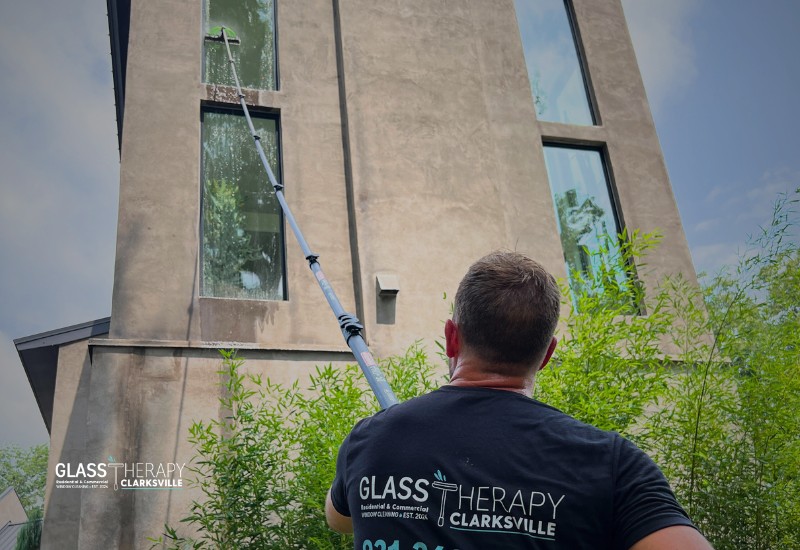
Dave Scribani runs Glass Therapy Clarksville just outside Nashville. Two years ago he was burning out as a marketing agency owner. Today he has five employees, three trucks, and is on pace to do $650,000 in window cleaning revenue this year — plus another $30K a month coaching other window cleaners on how to run their own ads. The whole thing started with a literal dream.
The Dream That Started a Window Cleaning Company
In April 2024, Dave was running a marketing agency he'd built up over years in the chiropractic and orthodontic spaces. The work was good. The money was good. But he was tired of sitting at a desk, and he was burnt out. Then one night he had a dream.
"In that dream, I had this massive company. There was a giant garage. I had dozens of trucks. My son, who is only 11, was working there too." He woke up, went to the gym, came home, and told his wife. Her response: "You should do it."
Dave walked into his office that morning and fired over $100,000 a year worth of marketing retainers on the spot. He shut the agency down the same day. By the afternoon, his wife had come back with a name and a logo: Glass Therapy Clarksville. He built the website that night, bought $500 worth of squeegees, practiced on his own house, and went door-knocking the next morning.
He made $1,000 his first day. $10,000 his first month. By June, he had enough to start running Meta ads — his actual specialty as a marketer — and never knocked another door again. Six months later, he was out of the field entirely. Year one closed at $300K. This year is on track for $650K.
0 to $650K in 24 Months
Dave started Glass Therapy Clarksville in April 2024 with $500 of equipment and a website he built himself. By month six he had hired his first two employees and stepped out of the truck. Today: five employees, three trucks, sixth hire in motion, and a coaching business that does another $30K/month teaching other window cleaners how to run their own ads.
Why 95% of Window Cleaners Stay Stuck
Dave's view of the industry is blunt. "95% of window cleaners are a one-man show. It's one guy in a truck. He doesn't have a CRM. He has no automation. He keeps track of his clients in his phone and misses calls like crazy."
The line he draws is the same one Sarah at Golden Rule draws: most operators in this industry don't own a business — they own a job. "You can make 100 grand a year cleaning windows by yourself, and there's nothing wrong with that. But a lot of guys want to scale and get out of the truck, and they have no idea where to turn."
Dave's answer is unambiguous: before you spend a dollar on marketing, you need a pipeline, a CRM, and automation. Otherwise you're lighting your ad budget on fire. Calls get missed, leads go cold, customers stop returning. The plumbing has to be in place first.
The Two-CRM Stack: HouseCall Pro + GoHighLevel
Dave runs two CRMs side by side, and he has a clear reason for each. HouseCall Pro is the system his team works in every day — invoicing, dispatch, scheduling, customer conversations. GoHighLevel sits underneath it as the automation engine.
"Think of HouseCall Pro as an iPhone. Clean cut. User friendly. It does what it does and it works no matter what you do. GoHighLevel is the Android. Super complex. You can tell it was designed by developers — even the language inside the system feels like that. But it can do anything."
The split makes sense once Dave explains the team dynamic. HouseCall Pro is the system he can train an admin or a tech to use in an afternoon. GoHighLevel is the system he uses to build invisible workflows that run in the background — the kind of stuff a non-technical employee shouldn't be touching anyway.
Why HouseCall Pro Won't Catch Up Soon
Dave's take on why HouseCall Pro will likely never have GoHighLevel-style automation: "HouseCall Pro has about 35 developers on staff. GoHighLevel has nearly 6,000." GoHighLevel treats automation as their core product and aggressively opens up the system for integrations and AI. Most home-service CRMs do the opposite — they lock the system down and don't even connect natively to Meta, where most leads come from.
Letting Claude Build the Automations
This is where Dave's setup gets genuinely interesting. He doesn't build his GoHighLevel workflows by hand anymore. He tells Claude what he wants and lets it take control of the screen.
"I told Claude what I wanted it to do. It takes control of the screen and I can watch it build. It built out a full reactivation workflow in about 30, 35 minutes. If I'd done it on my own, that's a seven or eight hour day. Or you could pay a GoHighLevel consultant $1,000 to build it for you."
The workflow itself is the kind of thing every service business should have but most don't: a residential reactivation campaign. Every customer gets tagged with the date of their last service. Six months out, the system checks whether they're a commercial account (skip), already booked (skip), or due for a follow-up. If they qualify, the first text goes out automatically. Seven days later, if no response, a second text fires.
$12,000 in One Day from a Workflow That Runs Itself
The reactivation workflow last fired the day before our interview. Dave checked the numbers: "That automation booked us $12,000 worth of work in one day. Just from following up with customers who hadn't had a window cleaning in six months." The cost to build it? About 35 minutes of Claude's time and a few prompts.
It's worth pausing on what's happening here. A marketing-savvy operator with no formal development background is using an AI agent to build production automation inside a complex CRM. The economics flip. What used to require a consultant or a developer is now a 35-minute conversation. And once one workflow is in, the next one — review requests, missed-call follow-ups, post-job upsells — is just another prompt away.
Where Dave Won't Use AI: The Phones
Dave is unusually firm on one boundary: AI doesn't get to talk to his customers. Not on calls. Not in the inbox. Not anywhere a human is expecting a human.
I try not to use AI in the business as far as customer experience goes, almost at all. I only leverage AI for the back end of building things, because I'm convinced most people, if you ask them, have no desire to talk to a robot.
— Dave Scribani, Glass Therapy Clarksville
He sees a lot of owner-operators in the trades reaching for AI phone receptionists and answering bots because they're drowning and can't yet afford a hire. He gets it. But he thinks the math is wrong. "It helps the owner. It doesn't serve the customer. We get calls all the time where people say, 'we tried to call another company and we couldn't get ahold of a human.'"
His solution is the boring one: hire a person. Glass Therapy has a full-time admin named Cindy. Every call goes to the same human voice. Dave's argument is that good employees don't cost you money — they make you money, because they keep the customer experience tight enough that the rest of the marketing actually works.
It's a useful counterpoint to Sarah's setup at Golden Rule, where the AI bots are explicitly customer-facing — but with names, personalities, and warm greetings. Two operators, two different lines drawn. Both intentional.
The Integration Wall (And Why It Hurts Trades the Most)
Dave's frustration with the home-services CRM landscape is the same one Sarah voiced in the last interview. The tools don't connect.
"A lot of CRMs don't allow integration with the AI platforms that exist today. They're locked up. They don't release that kind of access on the CRM side of things. Jobber, Markate, HouseCall Pro — these are decent CRMs, but they have everything locked. They don't even connect to Meta, which is wild. That's where most home-service business owners get their leads. So you have to use Zapier just to push your own data over to your own CRM."
GoHighLevel, by contrast, is the opposite philosophy: open up the system, let everyone customize and integrate, and let third-party agents like Claude operate inside it. That's why Dave runs both. HouseCall Pro for the things that need to be simple. GoHighLevel for everything that needs to be smart.
Teaching Other Cleaners to Fire Their Agency
About eight months ago Dave started a podcast with his friend Colby — a window cleaner in California with over a decade in the industry. They called it Clean for Profit. It quickly became one of the top home-service podcasts on Spotify.
The podcast turned into an unexpected funnel. Listeners kept reaching out asking Dave to run their ads. He had no interest in becoming an agency again. So he built a coaching program instead: three one-on-one calls. Call one is pipeline, CRM, and automation setup. Call two is content, scripts, and offer construction. Call three is launching the actual ads together, live.
In eight months he's worked with 125 window cleaners. Average outcome: students 12x their combined investment (coaching plus ad spend) within the first five days of launching. Dave's friend Colby — who he taught first — went from $33,000 in window-cleaning revenue all of last year to $60,000 in just the months since launching ads in January.
Agencies overpromise and underdeliver. No one cares about your business like you do, and no one is going to run ads better for your business than you, the business owner. Learn it yourself. And once you've learned it, then you can hire someone and delegate it.
— Dave Scribani, Glass Therapy Clarksville
The Trap Most Owners Fall Into With AI
Dave is bullish on AI as a back-end tool and skeptical of the way most owners are reaching for it. His worry isn't that AI will replace business owners. His worry is that it will let them avoid learning their own business.
"A lot of business owners don't want to take the time to actually learn things. Learn real skills. If there's a shortcut, our society wants it — fast and cheap. AI fits perfectly into that, because suddenly you don't have to think and you don't have to learn. The machine does it for you."
His prescription is simple: learn the skill first, then automate or delegate it. He learned to clean windows before he hired technicians. He learned Meta ads inside out before he ever taught them. Now he's learning to drive Claude as a builder before he leans on it operationally. The pattern is the same: master the human version, then bring in the leverage.
Dave's Framework for Owners Just Starting Out
- Get the plumbing in before you spend on ads. A pipeline, a CRM, and an automation layer. Without these, your ad spend is a leaky bucket — leads come in, leads fall out.
- Run two systems if you have to. The one your team works in (HouseCall Pro, Jobber) and the one that runs in the background (GoHighLevel). Don't force one tool to do both jobs poorly.
- Use AI to build, not to perform. Let Claude or another agent build out workflows, configure your CRM, and design follow-up sequences. Keep AI off the phone and out of customer-facing communication.
- Hire a real human as your first call answerer. Customers can tell. The trust you build by having a person pick up is worth more than the cost of the salary.
- Learn the skill before you delegate it. You can't manage what you don't understand. Run your own ads for a few months before you ever consider outsourcing them.
- Ignore the noise. Dave doesn't pay attention to competitors or trend cycles. He has a coach, a roadmap, and goals — and that's the whole input loop.
The Bottom Line
Dave's story is striking partly because of the speed — zero to $650K in two years is wild — but the more interesting part is the discipline behind where he uses AI and where he won't. AI builds his automations. AI does not answer his phones. A human is the front door of the business; an agent is the back office.
It's a different shape than Sarah's setup at Golden Rule, where AI bots have flower names and warm greetings and live closer to the customer. Two operators, two valid playbooks, both built by people who know the work and the tools cold. The thing they share is the underlying conviction: own the skill, then bring in the leverage. The trap is the inverse — outsourcing the skill before you've ever held it.
I'm not just an ad guy trying to get their money. I also do this. I put my money where my mouth is. And it's instant trust.
— Dave Scribani, Glass Therapy Clarksville
Ready to Automate Your Home Services Business?
Dave built his automation stack himself, then taught 125 other cleaners to do the same. If you'd rather skip ahead, that's where Robby comes in. We help home-service companies wire up AI-powered documentation, automated job tracking, and the kinds of integrations that bridge the gap between HouseCall Pro, ServiceTitan, GoHighLevel, and the rest of the stack.
Book a free demo and we'll walk you through your specific workflow and show you where the biggest wins are. No generic pitch, no agency retainer.
Home Services Leaders in AI
This article is part of our video series interviewing home-services business owners who are leading the charge with AI and automation. Follow along on our blog and LinkedIn for new interviews each month. Got a story to share, or know someone who should be on the list? We'd love to hear from you.
Read Next

From 3-Day Payroll to 15 Minutes: How Golden Rule Cleaning Runs on AI
10 min read

How AI Documentation Boosts HVAC Revenue by $135K Per Technician
6 min read
Ready to automate your HVAC documentation?
Join hundreds of HVAC companies using Robby to boost revenue and reduce callbacks.
Book a Demo